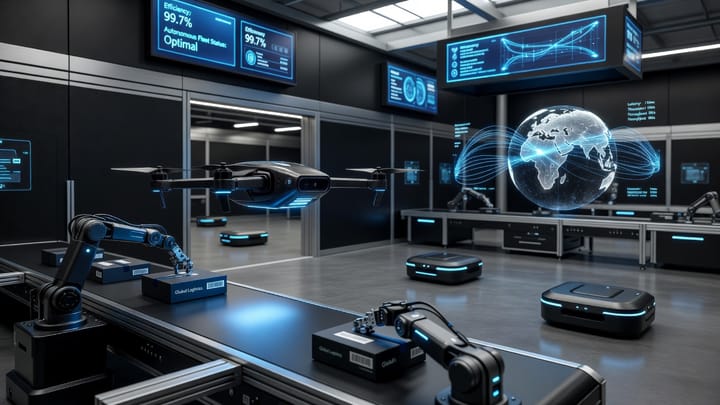

Did you know that by 2026, it's predicted that autonomous AI agents will handle over 50% of customer service inquiries? If that statistic doesn't make you pause and consider the seismic shift underway, then perhaps its direct implication for *your* business will: if you're not actively exploring how these intelligent digital entities can augment, automate, and revolutionize your operations, you risk being outmaneuvered by competitors who are.
The Genesis of Autonomous Business: Beyond Simple Automation
For years, we've talked about automation, often envisioning robotic arms on assembly lines or rudimentary chatbots handling FAQs. But what we are witnessing now, particularly as we approach 2026, is something far more profound. It's the era of AI agents - sophisticated, autonomous entities capable of understanding context, making decisions, and executing complex tasks with minimal human intervention. This isn't just about doing tasks faster; it's about fundamentally rethinking *how* work gets done, freeing up human capital for higher-level strategic thinking and innovation.
The shift from rule-based automation to intelligent, adaptable AI agents marks a new chapter. These agents are not static programs; they learn, evolve, and collaborate. They can analyze vast datasets, identify patterns, predict outcomes, and initiate actions across various business functions. This evolution is driven by advancements in large language models, reinforcement learning, and sophisticated planning algorithms, all converging to create digital workers that are increasingly indistinguishable from human counterparts in their problem-solving capabilities, albeit operating at machine speed and scale.
A Framework for Agent-Driven Operations: The ACES Model
To navigate this transformation, I've found it helpful to think in terms of a simple yet powerful framework: ACES. This stands for Autonomy, Collaboration, Efficiency, and Strategy. Each component is critical, but they are intrinsically linked, creating a virtuous cycle that propels businesses forward.
Autonomy refers to the agent's ability to operate independently, performing tasks from initiation to completion without constant human oversight. This is the bedrock, enabling tasks that were once bottlenecks to become seamless processes.
Collaboration highlights the agent-to-agent and agent-to-human interaction. AI agents aren't siloed; they can communicate, share information, and coordinate actions with each other and with human teams. This is where complex workflows begin to truly shine.
Efficiency is the most obvious outcome - reduced cycle times, lower operational costs, and minimized errors. This isn't just incremental improvement; it's about unlocking untapped potential.
Strategy is the ultimate goal. By automating the mundane and accelerating the complex, AI agents free up human leaders and teams to focus on high-level strategic planning, innovation, and competitive differentiation.
Applying the ACES model means asking critical questions: Where can we introduce autonomy? How can agents collaborate to solve problems? What efficiency gains are measurable? And critically, how does this shift enable our strategic objectives?

Unpacking the Power of AI Agents: Real-World Impact in 2026
Let's move beyond theory and look at how this is playing out across industries. The potential is staggering, and the early adopters are already seeing transformative results. We're seeing startups build entirely new business models around autonomous sales agents, capable of lead generation, qualification, personalized outreach, and even closing deals, operating 24/7 without fatigue. These aren't just glorified CRM tools; they understand nuanced customer needs and adapt their approach in real-time, a level of personalization previously unimaginable at scale.
In enterprise settings, the application is even more complex and impactful. Consider a global retail giant grappling with supply chain disruptions. They've deployed a multi-agent workflow where one agent monitors global news and weather patterns for potential disruptions, another agent analyzes inventory levels and demand forecasts across thousands of SKUs, and a third agent automatically re-routes shipments, negotiates with alternative logistics providers, and communicates updated delivery times to affected stores and customers. This entire process, which used to take days of human coordination and could be prone to errors, now happens in near real-time, with human oversight focused on strategic exceptions and performance tuning.
Another example: a mid-sized SaaS company in the healthcare tech space has implemented AI agents to manage their customer support and onboarding. One agent handles initial troubleshooting and guides users through common setup issues, freeing up human support staff to deal with more complex integration challenges or sensitive data queries. Another agent monitors user engagement within the platform, proactively reaching out to users who show signs of struggling or disengagement, offering targeted resources and personalized guidance. This has led to a significant reduction in churn and a marked improvement in customer satisfaction scores, demonstrating how AI agents can directly impact revenue and customer loyalty.
The real magic isn't in replacing humans, but in augmenting their capabilities to levels previously thought impossible. It's about creating a symbiotic relationship where AI handles the scale and speed, and humans provide the judgment, creativity, and empathy.
The measurable productivity gains are not just anecdotal. Companies are reporting up to a 30% reduction in operational costs in areas where AI agents have been deployed for repetitive, data-intensive tasks. Furthermore, error rates have plummeted, and response times have been slashed, leading to improved customer satisfaction and operational resilience. The untapped efficiencies lie not only in cost reduction but also in the accelerated innovation cycles and the ability to explore more complex market opportunities that were previously out of reach due to resource constraints.
Navigating the Inevitable Challenges
However, this revolution doesn't come without its hurdles. The complexity of integrating AI agents into existing legacy systems can be daunting. Ensuring seamless data flow, API compatibility, and robust security protocols requires significant technical expertise. We're seeing companies struggle with fragmented IT infrastructures, making it difficult to deploy agents that can interact across different platforms and departments.
Then there's the undeniable concern of workforce displacement. As AI agents take on more tasks, certain roles will inevitably evolve or diminish. This isn't a new fear with technological advancement, but the speed and breadth of AI's impact demand proactive, ethical responses. The focus must shift from job replacement to job evolution and augmentation.
Algorithmic bias is another critical challenge. If the data used to train these agents is biased, their decisions will reflect that bias, leading to unfair or discriminatory outcomes. Ensuring fairness, equity, and inclusivity in AI agent design and deployment is paramount. This requires meticulous data auditing, continuous monitoring, and diverse development teams who can identify and mitigate potential biases.
Leadership Imperatives: Steering the AI Revolution
As leaders, our role is not to simply adopt AI, but to strategically integrate it. This means understanding that AI agent deployment is a strategic imperative, not just a technological upgrade. It requires a clear vision, a commitment to ethical principles, and a culture that embraces continuous learning and adaptation.
The leadership perspective must be forward-looking. We need to ask: What is our long-term vision for AI in our organization? How can AI agents help us achieve our most ambitious strategic goals? Are we fostering an environment where employees feel empowered to collaborate with AI, rather than threatened by it?
Ethical considerations are non-negotiable. Transparency in how AI agents operate and make decisions is crucial. Accountability for their actions must be clearly defined. And data sovereignty - ensuring control over our data and its usage - is a fundamental right that AI adoption must respect. This means establishing robust governance frameworks that outline ethical guidelines, data privacy policies, and clear lines of responsibility.
Charting Your Future-Proof Strategy Today
The question for you, as a professional navigating this evolving landscape, isn't *if* AI agents will impact your business, but *how* and *when* you will leverage them. To thrive in this increasingly AI-driven economy, you need a proactive, future-proof strategy. Here's a concrete action plan:
Firstly, invest in upskilling roadmaps for your workforce. Identify critical skills that complement AI capabilities - strategic thinking, complex problem-solving, emotional intelligence, and AI oversight. Provide training opportunities, workshops, and access to resources. Consider partnering with educational institutions or online platforms to offer specialized courses.
Secondly, develop robust governance frameworks. This includes establishing clear ethical guidelines for AI development and deployment, defining accountability for AI-driven decisions, and implementing stringent data privacy and security protocols. A cross-functional AI ethics committee can be invaluable here.
Thirdly, adopt strategic pilot deployment models. Start with well-defined, contained projects that offer clear ROI and manageable risks. For instance, a pilot could focus on automating a specific customer service process or optimizing a particular segment of your supply chain. Measure the outcomes rigorously, learn from the experience, and scale gradually. The key is to experiment, iterate, and learn fast.
The journey into the era of AI agents is not a distant prospect; it is happening now. By understanding the principles, embracing the possibilities, and proactively addressing the challenges, you can position yourself and your organization to not just survive, but to lead in this transformative period.
As you look at your own operations, what is one specific area where you believe an autonomous AI agent could deliver the most immediate and impactful change for your team or business right now?