



Beyond Digital Transformation: The Dawn of Intelligent Operations
For the past 17 years, I have had the privilege of being on the front lines of the UAE's breathtaking technological evolution. I've worked with over 40 government entities, from the Prime Minister's Office to DEWA, witnessing firsthand our leadership's relentless drive to build not just a smart nation, but a truly intelligent one. We moved from paper to digital, and from digital to automated. But today, we stand at the threshold of a new revolution: Hyperautomation.
Many organizations have successfully deployed Robotic Process Automation (RPA) to handle repetitive, rules-based tasks. This was a crucial first step. However, real-world processes are rarely that simple. They are complex, dynamic, and filled with unstructured data, exceptions, and decisions that require human-like judgment. This is where simple automation hits a wall. Hyperautomation breaks through that wall by strategically combining RPA with the cognitive power of Artificial Intelligence (AI), Machine Learning (ML), and a suite of complementary technologies.
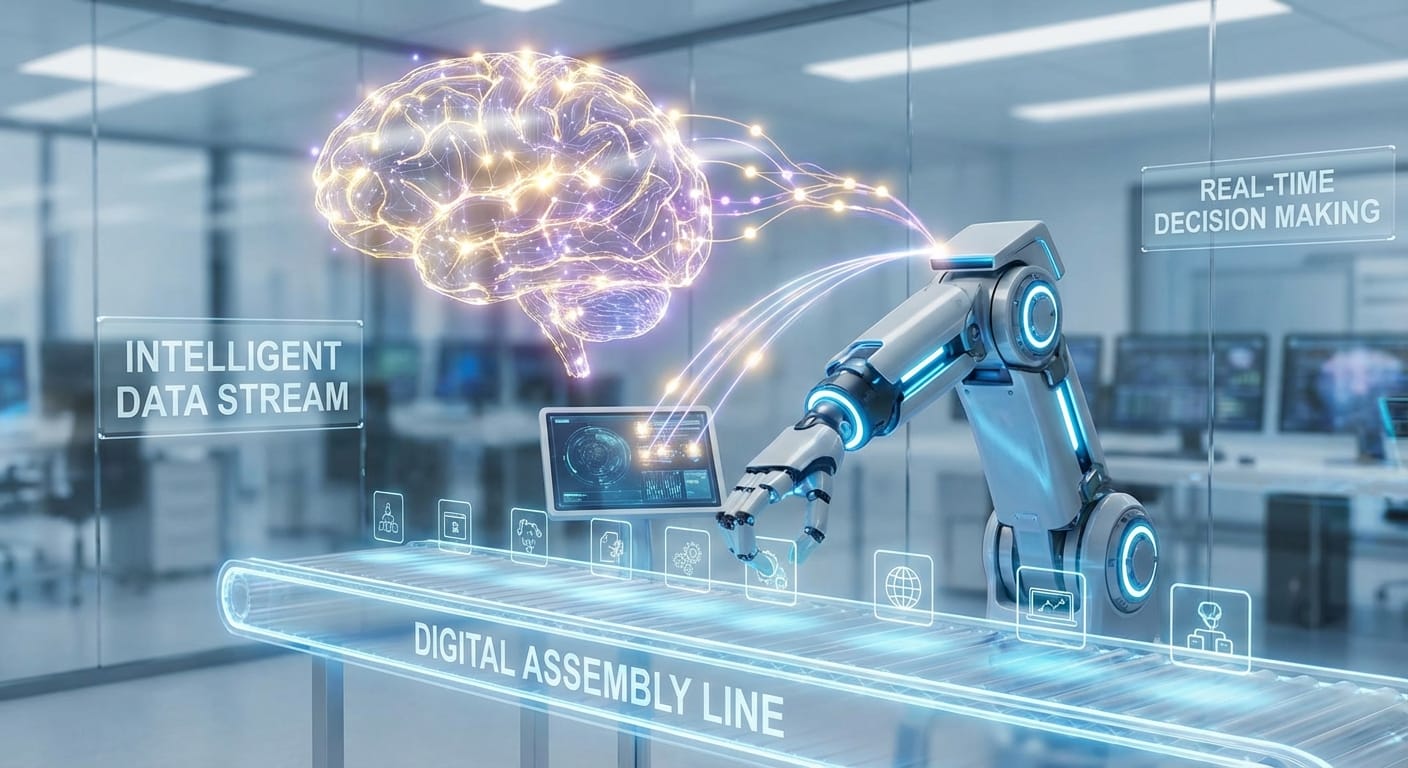
It's the difference between a bot that can copy-paste data and an intelligent system that can read a contract, understand its context, approve a loan, and learn from its decisions. For the UAE's ambitious public and financial sectors, this is not just an upgrade; it's a complete re-engineering of how value is delivered.
Hyperautomation in Action: From Trade Licenses to Loan Approvals
The true power of hyperautomation is realized when it's applied to complex, end-to-end workflows that are the lifeblood of our economy. Let's break down what this means in practical terms.
The Old Way: A Story of Friction
I recall a project with a major Dubai entity a few years ago responsible for issuing commercial permits. Their process was a labyrinth of manual checks. An application would arrive, an employee would manually verify documents against different government databases, check for compliance, flag discrepancies, and route it for multiple levels of approval. The process took weeks, was prone to human error, and created a significant bottleneck for new businesses. Their initial attempt with RPA helped digitize some steps, but the bots would halt every time they encountered a non-standard document or a complex compliance query, creating more work for the human team.
The Hyperautomation Solution
This is where we go beyond basic RPA. A hyperautomated workflow integrates a suite of intelligent tools:
- Intelligent Document Processing (IDP): AI models use Natural Language Processing (NLP) and Optical Character Recognition (OCR) to read and understand unstructured documents like trade licenses, Emirates IDs, and financial statements, extracting relevant data with superhuman accuracy.
- AI-Powered Decision Engines: Machine learning models are trained on historical data to assess risk, check for regulatory compliance, and make initial approval recommendations for processes like loan applications or license renewals.
- Process Mining Tools: These tools analyze your existing workflows to identify hidden bottlenecks and inefficiencies, providing a data-driven roadmap for what to automate next for maximum impact.
- Advanced Analytics: Dashboards provide real-time insights into process performance, enabling continuous improvement and predictive forecasting.
Hyperautomation is not about incremental improvement. It is a strategic discipline that redesigns how work gets done, freeing human capital from process execution to focus on innovation, strategy, and customer experience.
The impact of this integrated approach is transformative. A process that once took weeks of manual effort can be reduced to hours, or even minutes, with a higher degree of accuracy and compliance.
The NICGulf Blueprint: A 5-Year Journey to 80%+ Efficiency
At NICGulf, we have spent the last five years pioneering and perfecting hyperautomation solutions specifically for Dubai and the wider UAE. Our track record speaks for itself: we have consistently helped government and financial entities achieve efficiency gains upwards of 80%. This isn't just about speed; it's about creating more resilient, scalable, and citizen-centric operations.
Let's compare the evolution of a typical high-volume process, like SME loan processing, to see the tangible benefits.
| Metric | Traditional Manual Process | RPA-Only Automation | Hyperautomation (RPA + AI) |
|---|---|---|---|
| Avg. Processing Time | 15 - 20 Business Days | 5 - 7 Business Days | Under 24 Hours |
| Manual Error Rate | 5% - 8% | ~2% (at exception points) | < 0.5% |
| Cost Per Transaction | High (heavy labor cost) | Medium | Low (up to 75% reduction) |
| Audit & Compliance Trail | Manual, fragmented | Partially logged | Fully automated, immutable log |
Data based on aggregated results from NICGulf projects in the UAE financial and public sectors (2019-2024).
Your Roadmap to Intelligent Automation
Embarking on a hyperautomation journey requires a strategic, phased approach. It's not about a 'big bang' implementation but about building momentum and demonstrating value at every stage.
- Discover & Strategize: Utilize process mining and workshops with key stakeholders to identify high-impact, complex processes that are ripe for hyperautomation. Develop a clear business case and a strategic roadmap.
- Build the Foundation: Establish a Center of Excellence (CoE) to govern your automation initiatives. Select a flexible and scalable technology platform that integrates RPA, AI, and analytics capabilities.
- Pilot & Prove: Start with a pilot project that has a clear scope and measurable success criteria. This builds confidence, secures buy-in from leadership, and provides valuable lessons for future scaling.
- Scale & Optimize: Once the pilot is successful, begin scaling the solution across the organization. Implement a framework for continuous monitoring and optimization, allowing the system to learn and improve over time.
Conclusion: Build for the Future, Today
The UAE's vision is not just to adopt the future, but to actively build it. Hyperautomation is a cornerstone of this vision. It is the engine that will power the next generation of seamless government services and hyper-efficient financial institutions. By intelligently automating end-to-end processes, we are not just cutting costs or saving time; we are fundamentally enhancing our nation's competitiveness on the global stage.
For over five years, NICGulf has been a dedicated partner in this journey, translating ambitious strategies into tangible operational excellence. If you are a leader in the public or financial sector looking to move beyond simple automation and unlock the transformative power of AI, the time to act is now. Let's connect and start architecting your hyperautomated future.