


From our NICGulf office in Dubai, I often look out at the skyline of Business Bay. It's a powerful symbol of ambition, innovation, and rapid growth. Over my 16+ years in technology, I've seen countless enterprises ride the wave of digital transformation. Here in the GCC, that wave is a tsunami. The drive to innovate is immense, but it's matched by an equally critical need for data security and regulatory compliance. This creates a fundamental tension for every CIO and CTO: how do you embrace the limitless scalability of the public cloud without compromising the ironclad control of a private, on-premise environment?
For years, the debate was framed as a binary choice: Public vs. Private. You could have agility or you could have control. You could have cost-efficiency or you could have bespoke security. But you couldn't have it all. This is the outdated thinking that holds businesses back. The modern enterprise, especially in a dynamic region like the GCC, doesn't operate in absolutes. The answer isn't choosing a side; it's architecting a smarter solution that leverages the best of both worlds. The answer is a robust, well-managed hybrid cloud strategy.
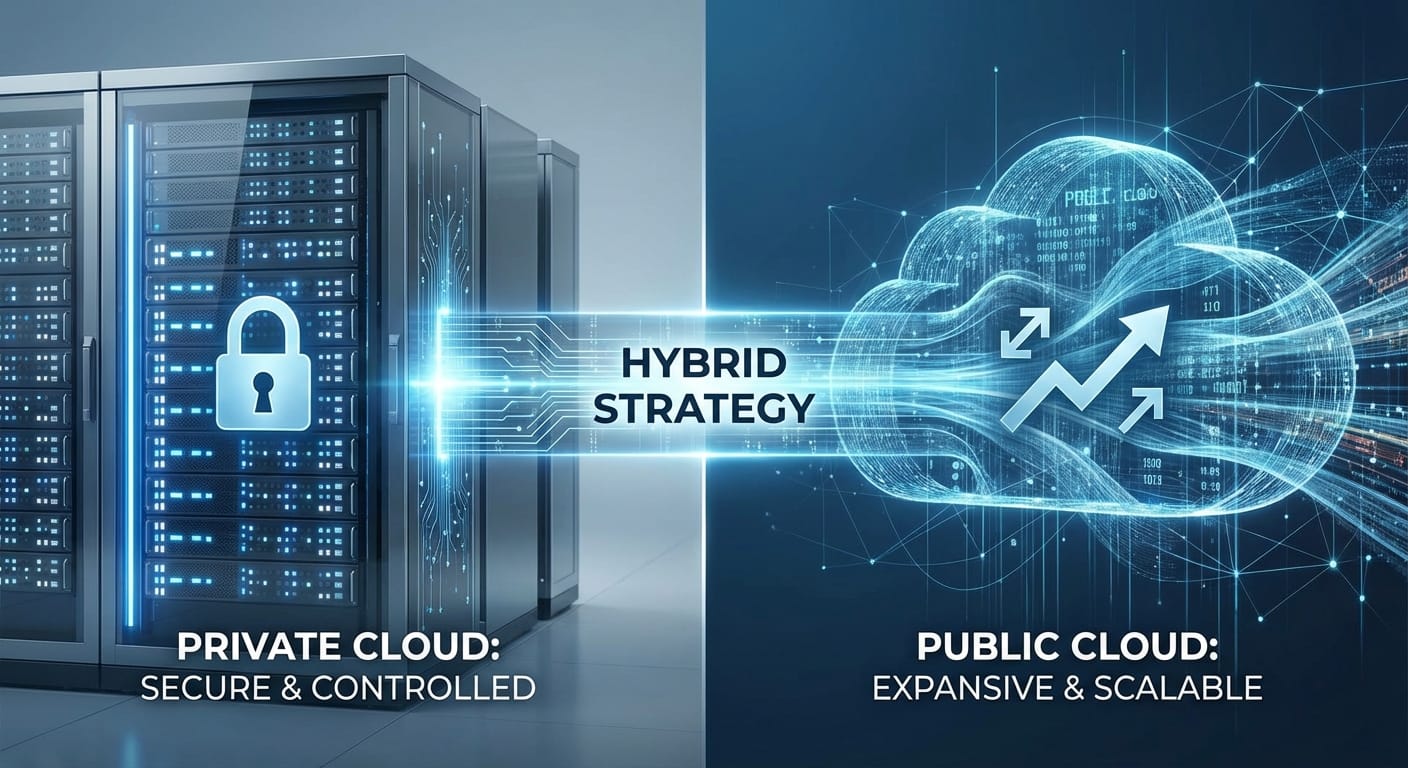
This isn't just a technological compromise; it's a strategic masterstroke. It's about creating a fluid, secure, and powerful infrastructure that allows you to place workloads precisely where they belong, optimizing for performance, cost, and compliance simultaneously. It's about building a digital foundation that is as ambitious and resilient as the enterprises it supports.
Navigating the GCC's Unique Cloud Landscape
The push for cloud adoption in the GCC is fueled by national visions for economic diversification and digitalization. However, this region has a unique set of considerations that makes a one-size-fits-all approach to cloud dangerous. Data sovereignty is not just a best practice; it's often the law. Understanding this dichotomy is the first step toward building a successful cloud strategy.
The Public Cloud Pull: Infinite Scale and Innovation
The appeal of public cloud providers like AWS, Microsoft Azure, and Google Cloud is undeniable. They offer incredible benefits:
- Elastic Scalability: Handle massive traffic spikes during a retail event like White Friday or a major marketing campaign without overprovisioning hardware.
- Cost Efficiency: Move from a heavy capital expenditure (CapEx) model of buying servers to a flexible operational expenditure (OpEx) model, paying only for the resources you consume.
- Access to Innovation: Leverage cutting-edge services in AI, machine learning, and big data analytics without the massive upfront investment in infrastructure and talent.
For customer-facing applications, development environments, and data analytics on non-sensitive data, the public cloud is an unparalleled engine for growth.
The Private Cloud Imperative: Security and Sovereignty
On the other side of the coin are the non-negotiables. For GCC enterprises in sectors like finance, healthcare, and government, certain data simply cannot leave the premises-or the country. A private cloud, whether on-premise or hosted locally, provides:
- Total Control: Complete authority over the hardware, network, and security configurations, allowing for highly customized security postures.
- Regulatory Compliance: Ensures adherence to strict data residency and sovereignty laws, such as the UAE's Personal Data Protection Law (PDPL), which governs how customer data is processed and stored.
- Predictable Performance: Guarantees resource availability and low latency for mission-critical, core business applications that cannot tolerate performance fluctuations.
Hybrid Cloud: The Strategic Synthesis for GCC Leaders
A hybrid cloud strategy elegantly resolves the public vs. private conflict. It creates a unified, integrated environment where data and applications can be shared between the two. Think of it as a financial portfolio: you don't put all your assets in one high-risk stock or one low-yield bond. You diversify. A hybrid cloud is a diversified infrastructure portfolio.
I remember working with a leading financial services firm in Dubai a couple of years ago. They wanted to use advanced AI-driven fraud detection models available on a public cloud platform, but their core transactional data was subject to strict residency rules and could not be moved. The 'all or nothing' approach was failing them. We architected a hybrid solution where raw, sensitive transaction data remained secure in their on-premise private cloud. An automated process would then anonymize and strip this data of all personally identifiable information (PII) before sending it to the public cloud for analysis by the AI model. The resulting insights and risk scores were then sent back to their secure environment. They gained world-class fraud detection capabilities without ever compromising on security or compliance. That is the power of a thoughtful hybrid strategy.
The goal of a modern IT infrastructure is not to lock data down, but to liberate its value securely. Hybrid cloud provides the keys to do just that, offering a master key for innovation and a dedicated key for control.
The decision on where to place a workload becomes a strategic one, based on a clear set of criteria. This comparative table breaks down the core trade-offs:
| Factor | Public Cloud | Private Cloud | Hybrid Cloud |
|---|---|---|---|
| Scalability | Virtually limitless, on-demand | Limited by owned hardware | Best of both (cloud-bursting) |
| Control & Security | Shared responsibility model | Full, granular control | Granular control for sensitive data, flexible for others |
| Cost Model | OpEx (Pay-as-you-go) | CapEx (High initial investment) | Optimized blend of OpEx and CapEx |
| Compliance | Can be complex for data sovereignty | Ideal for strict data residency | Enables compliance by design |
The NICGulf Advantage: Your Managed Hybrid Cloud Partner
Designing a hybrid cloud is one thing; managing it is another. The complexity of orchestrating workloads, ensuring seamless connectivity, maintaining a unified security posture, and optimizing costs across multiple environments can be overwhelming for internal IT teams. This is where a managed services partner becomes essential.
At NICGulf, we act as the strategic layer on top of your hybrid infrastructure. We help firms right here in Business Bay and across the GCC to:
- Design the Right Architecture: We analyze your applications and data to build a bespoke hybrid model that aligns with your business goals and compliance requirements.
- Implement and Integrate: We handle the complex technical work of connecting your private and public cloud environments securely and efficiently.
- Manage and Optimize: Our team provides 24/7 monitoring, security management, and continuous cost optimization, ensuring your cloud environment is always performant, secure, and cost-effective.
- Ensure Governance: We help you maintain control and visibility across your entire infrastructure, simplifying compliance and reporting.
By entrusting the management to us, your team is free to focus on what they do best: driving business innovation.
Conclusion: Build Your Future-Ready Foundation
The digital future of the GCC will not be built solely in the public cloud or guarded exclusively within private data centers. It will be built on the intelligent, flexible, and secure foundation of a hybrid cloud. This approach empowers your organization to scale fearlessly, innovate freely, and operate securely, all while maintaining full control over your most sensitive digital assets. It transforms IT infrastructure from a rigid cost center into a dynamic enabler of business strategy.
The question is no longer if you should adopt a hybrid strategy, but how you can architect it for maximum competitive advantage. Let's start that conversation. We're here in Dubai, ready to help you build your blueprint for success.