



Standing on a project site in Jebel Ali over a decade ago, watching the relentless hum of industry, the concept of 'sustainability' often felt like an abstract goal, a checkbox on a corporate responsibility report. We talked about efficiency, yes, but the tools we had were blunt instruments, relying on historical data to make future guesses. Today, that landscape has been completely terraformed. The conversation in every major boardroom in Dubai, from DIFC to Dubai Internet City, is no longer just about profit, but about purpose, driven by a powerful new force: Artificial Intelligence.
The UAE's Green Agenda 2030 and its commitment to Net Zero by 2050 are not just government mandates; they are a fundamental reshaping of our economic DNA. For the corporate sector, this presents both a profound challenge and an unprecedented opportunity. The challenge is the complexity of measuring, managing, and reporting on environmental, social, and governance (ESG) metrics. The opportunity is to leverage technology to turn sustainability from a compliance burden into a core driver of innovation, efficiency, and competitive advantage. The era of manual carbon accounting and retroactive reporting is over. The era of the green algorithm has begun.
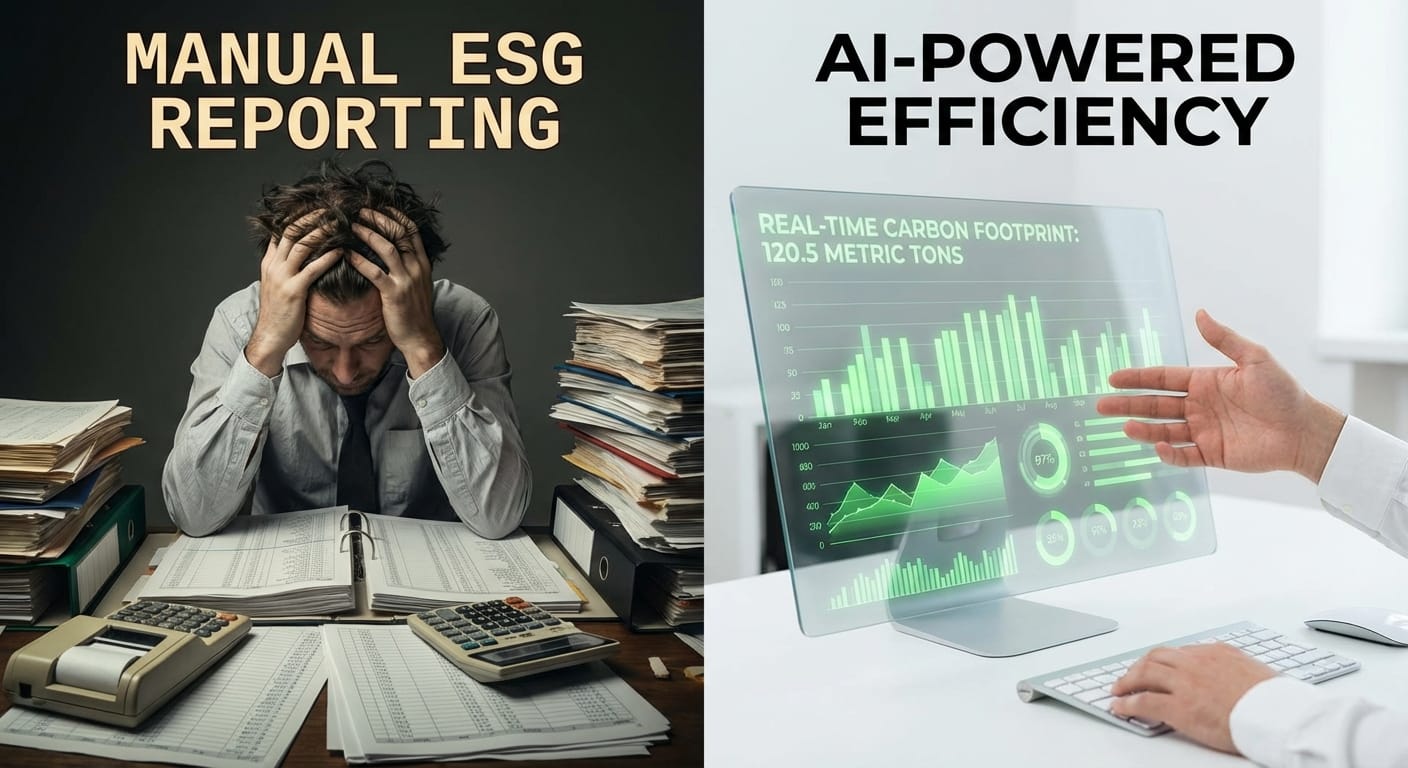
This transition is where my work as an AI strategist becomes most critical. We are now building intelligent systems that provide not just a rearview mirror of a company's environmental impact, but a predictive, real-time dashboard for navigating the future. It's about embedding sustainability into the operational fabric of a business, making it as measurable and manageable as financial performance.
Beyond the Spreadsheet: AI's Revolution in ESG and Sustainability
For years, ESG reporting has been a painstaking, manual process. It involved teams of consultants sifting through utility bills, supply chain invoices, and operational logs, trying to stitch together a coherent picture of a company's carbon footprint. The process was slow, expensive, and often riddled with inaccuracies. AI completely dismantles this archaic model, introducing a level of precision and speed that was previously unimaginable.
From Manual Audits to Real-Time Intelligence
I recall a project with a major logistics and shipping firm. Their sustainability team spent the first quarter of every year manually compiling data from the previous year for their annual report. The data was siloed-fuel consumption from their fleet, electricity usage from their warehouses, waste management reports from their facilities. By the time the report was published, the data was already six months out of date, making it useless for timely operational decisions. It was an exercise in compliance, not a tool for change. Today, with AI-powered platforms, we can connect directly to those same data sources-IoT sensors on vehicles, smart meters in buildings, digital procurement systems-and analyze the information in real-time. An executive can now see the carbon impact of a specific shipping route as it happens, not months after the fact.
The NICGulf Edge: Precision Carbon Tracking
This is precisely where specialized tools, like those we develop at NICGulf, are creating a paradigm shift. Our AI platforms are engineered to automate the entire data lifecycle for carbon accounting. They ingest unstructured data from hundreds of sources, use machine learning models to accurately calculate emissions across Scope 1, 2, and 3, and generate audit-ready reports that align with global standards like the GHG Protocol and TCFD. This frees up human capital to focus on what truly matters: developing strategies to reduce emissions, not just report on them.
In the new corporate paradigm, sustainability is no longer a cost center; it's a strategic imperative. AI provides the intelligence to transform this imperative from a complex burden into a competitive advantage.
Architecting a Greener Future: Sustainable IT and Competitive Advantage
The drive for sustainability extends beyond reporting and into the very infrastructure that powers our businesses. The energy consumption of data centers and digital infrastructure is a significant, and growing, part of the global carbon footprint. In a digitally-driven economy like Dubai's, optimizing IT for efficiency is not just good for the planet; it's a critical business decision. This is where the concept of 'Green IT' becomes central to corporate strategy.
AI plays a dual role here. First, it helps us design and manage more efficient IT systems. AI algorithms can optimize data center cooling, predict energy load requirements, and dynamically allocate computing resources to minimize power consumption. This directly reduces a company's operational costs and its Scope 2 emissions. Second, by moving computational tasks to efficient, modern cloud architectures, companies can further slash their energy footprint. A study by Accenture found that migrating to the public cloud can reduce CO2 emissions by up to 59 million tons per year, which is the equivalent of taking 22 million cars off the road. The data clearly shows the operational and environmental gap between traditional ESG methods and an AI-driven approach.
| Metric | Traditional ESG Reporting | AI-Powered Sustainability Platform |
|---|---|---|
| Data Accuracy | ~80-85% (Prone to human error) | 95%+ (Automated validation & anomaly detection) |
| Time to Report | Weeks or Months | Real-time / Days |
| Operational Cost Reduction | Baseline | 30-50% Reduction (in reporting & compliance costs) |
| Strategic Value | Compliance / Historical Record | Predictive Insights & Proactive Strategy |
Source: Based on 2024 market analysis from firms like McKinsey and Gartner on AI in ESG.
Your Roadmap to AI-Powered Sustainability
For corporate leaders in Dubai and beyond, the path forward is clear. Integrating AI into your sustainability strategy is essential for staying compliant, competitive, and credible in a world that increasingly values corporate responsibility. The journey begins with a strategic shift in mindset, followed by tactical implementation.
Here are the key pillars for building your AI-powered sustainability framework:
- Automate Data Collection: Identify all sources of emissions data across your operations and implement automated systems to ingest this information into a central platform. Eliminate manual data entry wherever possible.
- Deploy a Unified AI Platform: Invest in a comprehensive solution, like NICGulf's, that can manage data, perform calculations, identify reduction opportunities, and generate reports from a single source of truth.
- Integrate Sustainability with Finance: Use AI to link environmental performance directly to financial metrics. Model the ROI of sustainability initiatives, from energy-efficient upgrades to supply chain optimizations.
- Foster a Culture of Transparency: Leverage the precision of AI-driven reporting to communicate your ESG performance confidently to investors, customers, and regulators. Use the data to tell a powerful story of progress and commitment.
The UAE has always been a place where ambitious visions are transformed into reality. The Green Agenda is our latest national ambition, and technology is the catalyst that will make it happen. For the companies ready to embrace the green algorithm, the future is not just sustainable-it is smarter, more efficient, and ultimately, more profitable. The question is no longer if you should adopt these tools, but how quickly you can lead the charge. Connect with architects of sustainable AI, and let's build that future together.