



For the better part of my 25 years in the technology industry, I've held a firm belief: the majority of meetings are where productivity goes to die. We'd spend an hour debating, brainstorming, and deciding, only to have the most critical action items vanish into the ether of poorly-kept notes or conflicting recollections. We were data-rich but insight-poor. Then came the first wave of AI meeting assistants, and for a moment, it felt like salvation. Suddenly, we had perfect, word-for-word transcripts. The problem? A 60-minute meeting now produced a 20-page document that no one had time to read. We had simply traded one problem for another.
This is the challenge I see leaders grappling with globally, from the bustling tech parks of Bangalore to the gleaming innovation hubs of Dubai. In a city like Dubai, which is relentlessly architecting its future around smart services and hyper-efficiency, this isn't just an inconvenience; it's a critical bottleneck. The city's ambition moves at the speed of light, and administrative drag is the enemy of progress. This is where the real work begins: not just adopting AI, but architecting intelligent workflows around it. It's a strategy we've been refining at firms like NICGulf, transforming a passive transcript into a high-velocity engine for project execution.
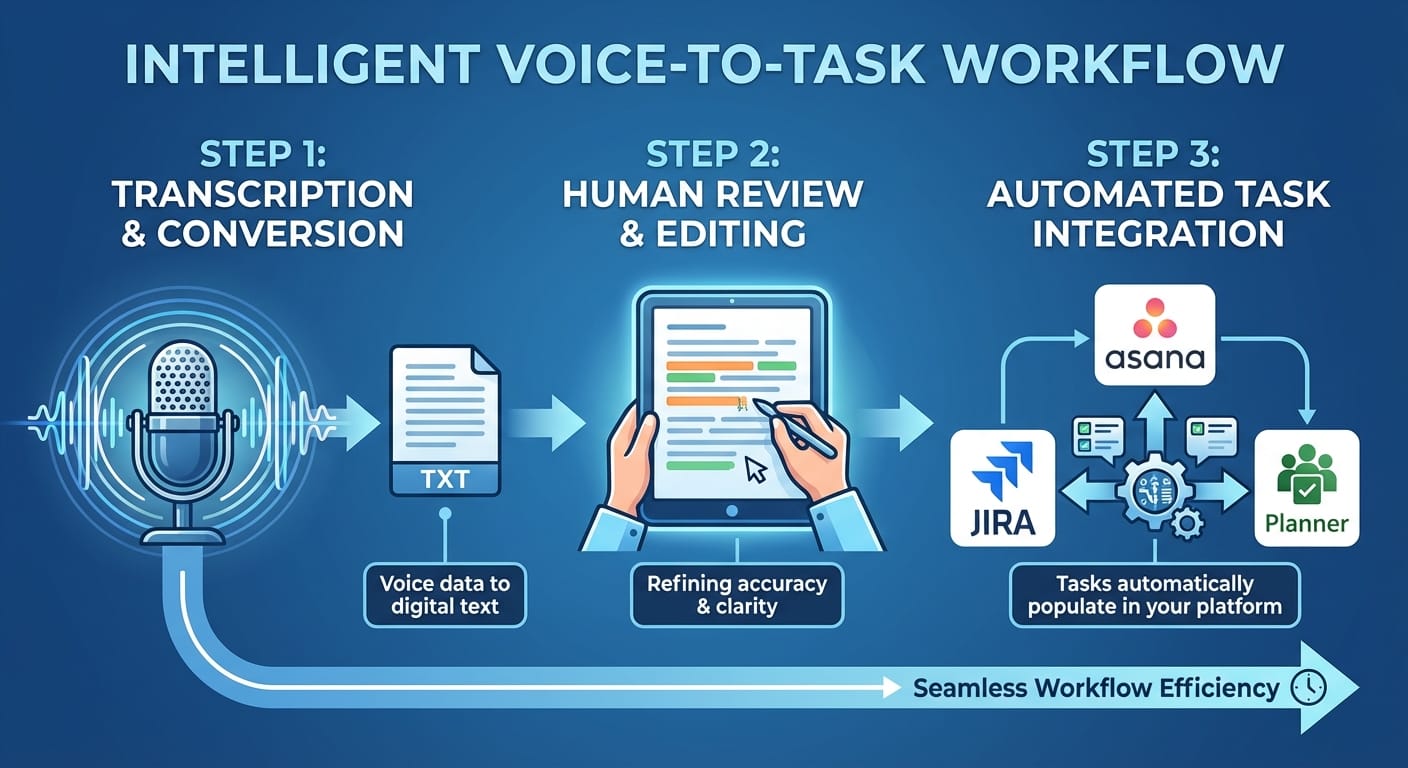
The solution isn't another tool. It's a new leadership methodology, one that leverages AI to do what it does best-process and parse data-so that we, as leaders, can do what we do best: provide context, make strategic decisions, and inspire action.
From Passive Transcription to Proactive Execution
The initial promise of tools like Otter.ai and Fireflies.ai was seductive: a perfect record of every conversation. We celebrated the end of the note-taker role. However, the first-order result was information overload. A verbatim transcript lacks context, hierarchy, and, most importantly, a sense of priority. Who owns what? What's the deadline? What is a genuine commitment versus a casual suggestion? The raw text, for all its accuracy, is strategically inert.
This is where I recall a painful lesson from early in my career, around the late 90s. We were building a complex logistics platform for a client in Europe. During a critical three-hour workshop, the lead architect outlined a subtle but crucial dependency in the database schema. It was mentioned once. Our designated note-taker, a junior developer, missed the nuance. The written minutes just said, "Discussed database schema." Six weeks later, that single missed detail cost us a full month of rework and nearly fractured our relationship with the client. A perfect transcript would have captured the words, but the *importance* would have remained buried. Today's AI, when properly directed, solves this very problem.
The NICGulf Blueprint: A 3-Step Activation Engine
In Dubai's fast-paced environment, there's no time for archaeological digs through meeting notes. Inspired by the principles of smart governance, our partners at NICGulf developed a simple but powerful workflow to weaponize meeting transcripts. It's about turning a record of the past into a plan for the future, automatically.
- Automated First-Pass Analysis: The AI assistant is configured to do more than transcribe. It generates a concise, executive-level summary, identifies key topics, and flags potential action items based on trigger phrases like "we need to," "the next step is," or "assign this to." This is the baseline, the raw material.
- Human-in-the-Loop for Strategic Context: The AI-generated summary and tasks are automatically sent to the meeting host or project lead. This is the critical human touchpoint. The leader spends 5-10 minutes-not 60-reviewing the output. They can correct any misinterpretations, elevate the priority of a task the AI missed, or add a layer of strategic context that the machine cannot comprehend.
- Direct Integration into Execution Platforms: This is the final, and most crucial, step. Once validated by the leader, these action items are not emailed out. They are pushed directly into a project management system like Jira, Asana, or Microsoft Planner via API integrations. The task arrives pre-populated with the owner, a suggested deadline, and, most powerfully, a link to the exact timestamp in the meeting transcript where the task was discussed.
Quantifying the Leadership Dividend
When you shift from manual meeting administration to an AI-augmented workflow, the time savings are immediate and substantial. It's not just about eliminating the chore of writing minutes; it's about collapsing the entire cycle from discussion to delegation. We are not just saving time; we are buying back focus, which is the most valuable currency a leader has.
The goal of AI in the workplace isn't to replace the leader's judgment, but to liberate it. By automating the 'what', we free up our best minds to focus on the 'why' and the 'how'. It's the difference between being a meeting stenographer and being a corporate strategist.
To put this in perspective, consider the weekly administrative burden on a typical team lead or manager responsible for multiple projects.
| Meeting-Related Task | Time Spent Per Week (Before AI) | Time Spent Per Week (With AI Workflow) | Weekly Time Reclaimed |
|---|---|---|---|
| Attending and taking notes during meetings | 5-7 Hours | 5-7 Hours (Focus is on participation, not typing) | 0 Hours (Qualitative Improvement) |
| Consolidating notes & writing summaries | 3-4 Hours | 0.5 Hours (Reviewing/Editing AI summary) | 3 Hours |
| Identifying and creating tasks in PM tools | 2-3 Hours | 0.5 Hours (Reviewing/Assigning AI tasks) | 2 Hours |
| Following up on unclear action items | 2-3 Hours | 0.25 Hours (Context is linked in the task) | 2.25 Hours |
| Total Administrative Overhead | 12-17 Hours | 6.25-8.25 Hours | ~10 Hours Saved |
Data based on internal studies and market analysis of managerial time allocation in tech firms (2024).
Activating Your Meetings: A Leader's Action Plan
Implementing this system is not a massive IT project. It's a shift in team habits, championed by leadership. You can start this transformation next week.
- Define Your Triggers: Work with your team to establish clear verbal cues for action items. Phrases like "Action for Sandeep is..." or "Commitment for the design team is..." can be used to train the AI.
- Choose Your Integration Stack: Ensure your chosen AI assistant (e.g., Fireflies) has robust, native integrations with the project management tools your team already uses (e.g., Jira, Asana, Trello).
- Pilot with a Single Team: Roll this out with one agile, tech-forward team. Let them become the champions and help you build a best-practice model for the rest of the organization.
- Measure and Iterate: The goal is not perfection, but velocity. Track key metrics: time from meeting to task creation, task completion rates, and qualitative feedback from the team.
The Future is Action-Oriented
Dubai's vision of a seamlessly integrated smart city is a powerful metaphor for the modern organization. Silos are being dismantled, data flows intelligently, and human effort is directed toward its highest and best use. Our meetings must follow this model.
We have an opportunity to fundamentally redesign one of the most broken processes in modern business. Stop treating meetings as a forum for discussion and start treating them as the first step in a chain of automated execution. The technology is here. The methodologies, as pioneered in hyper-growth environments like Dubai, are proven. The only missing piece is leadership with the vision to demand more than just a transcript.
Stop recording your meetings. It's time to start activating them.