



In my role overseeing operations and infrastructure at IndiaNIC, I've spent years focused on building the solid foundations that allow innovation to flourish. Whether it's setting up a new office or architecting a flawless internal network, I've learned that the most impressive achievements are always supported by an invisible, meticulously planned infrastructure. Today, as I look at the incredible smart city ambitions of the Middle East, I see this principle playing out on a monumental scale. The gleaming towers and futuristic metro lines are just the visible layer. The real revolution is happening in the digital realm, and nowhere is this more apparent than in the push toward autonomous public transport.
Cities like Dubai and Riyadh are not just adding self-driving vehicles; they are completely reimagining mobility. Their vision is of a seamless, efficient, and safer urban experience, powered by fleets of autonomous shuttles, taxis, and buses. This isn't science fiction-it's a strategic imperative aimed at boosting economic productivity, enhancing quality of life, and achieving ambitious sustainability goals. But for a single self-driving car to navigate a street safely, it requires a support system of unimaginable complexity. This is where the true challenge lies, and it's a challenge being met by the advanced software engineering expertise of companies like NICGulf.
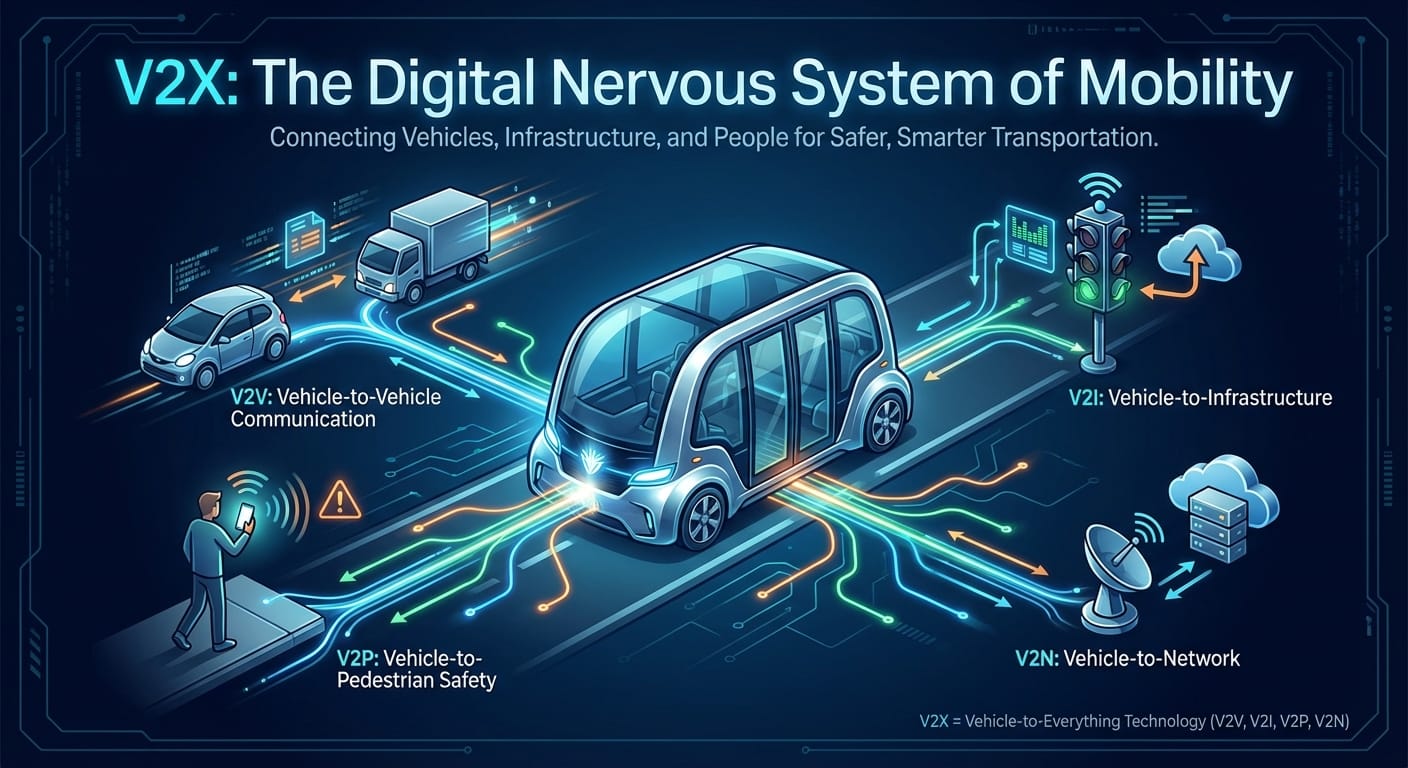
They are building the digital highways-the intricate communication networks-that will allow this autonomous future to become a reality. It's one thing to build a road of asphalt and concrete; it's another entirely to build a resilient, intelligent network where data flows as reliably as the vehicles themselves.
The Unseen Engine: V2X Communication Networks
An autonomous vehicle, in isolation, is only partially intelligent. Its true potential is unlocked when it can communicate with everything around it. This is the concept of Vehicle-to-Everything (V2X) communication, the digital nervous system of a smart city's transport network. It allows vehicles to talk to other vehicles (V2V), to traffic infrastructure like signals and sensors (V2I), and even to pedestrians' devices (V2P). This constant exchange of data allows for a level of coordination and safety that a human driver could never achieve.
Why the Network is Everything
Imagine a scenario where an ambulance needs to get through a congested intersection. In a V2X-enabled city, the ambulance broadcasts its approach. Traffic lights ahead turn green, and other vehicles are instructed to slow down or pull over, clearing a path automatically and safely. This level of synchronization relies entirely on the underlying software and communication network. A single dropped data packet or a moment of lag could be catastrophic. This is not a standard IT network; it's a mission-critical, life-sustaining infrastructure.
I'm often reminded of the time we were setting up a new development center. The challenge wasn't just getting desks and chairs in place; it was architecting a network infrastructure with zero points of failure. We had hundreds of developers working on mission-critical projects, and even a millisecond of network lag could disrupt workflows, while downtime was simply not an option. We spent weeks planning every detail: redundant connections, backup power, load balancing. When I look at the challenge of an autonomous transport network, I see the same principle magnified a thousand times. Here, latency isn't about inconvenience; it's about safety. A dropped data packet isn't a bug; it's a potential accident. The meticulous engineering that goes into the unseen digital infrastructure is what ultimately makes the physical journey safe and reliable.
NICGulf's Role: Architecting the Digital Backbone for Mobility
Building a robust V2X network is fundamentally a software engineering challenge. It requires a deep understanding of real-time data processing, cybersecurity, and scalable cloud infrastructure. This is where NICGulf's expertise becomes the critical enabler for the Middle East's autonomous vision. They are not just developing apps; they are architecting the foundational systems that allow the entire ecosystem to function.
We often admire the sleek designs of self-driving pods, but the true revolution is invisible. It's in the millions of lines of code and the resilient, low-latency communication networks that form the digital highways of tomorrow. The physical vehicle is just the endpoint of a vast, intelligent operational system.
The core components of this digital backbone include:
- Real-Time Data Processing Engines: These systems must ingest and analyze terabytes of data from thousands of vehicles simultaneously, making decisions in milliseconds.
- Low-Latency Communication Protocols: Developing and implementing protocols that ensure data is transmitted between vehicles and infrastructure with near-instantaneous speed.
- Edge Computing Solutions: Placing computational power closer to the vehicles to reduce reliance on centralized data centers and minimize latency for critical safety decisions.
- Advanced Cybersecurity Frameworks: Protecting the network from malicious attacks that could compromise vehicle control or steal sensitive data.
- Fleet Management and Orchestration Platforms: Creating centralized dashboards for city operators to monitor the health, location, and performance of the entire autonomous fleet.
The performance leap from traditional urban transport to a V2X-enabled autonomous system is significant, as projected data from industry analysis shows.
| Mobility Performance Metric | Conventional Transport System | Autonomous V2X-Enabled System |
|---|---|---|
| Traffic Congestion Reduction | Baseline | Up to 40% improvement |
| Accident Rate Reduction | Baseline | Projected up to 90% reduction |
| Travel Time Efficiency | Variable | Up to 30% faster and more predictable |
| Fuel/Energy Efficiency | Baseline | Up to 20% improvement through coordination |
The Phased Journey to a Driverless Future
The rollout of city-wide autonomous transport is not a flip of a switch. It's a carefully orchestrated, multi-stage process that relies on iterative software development and infrastructure deployment. The typical data and command flow in these sophisticated systems follows a clear path:
- Data Ingestion: On-board vehicle sensors (LiDAR, cameras, radar) capture billions of data points about the immediate environment.
- On-Board Processing: The vehicle's internal computer makes instant decisions for steering, braking, and acceleration based on sensor data.
- V2X Communication: The vehicle shares critical data (speed, position, intent) with nearby vehicles and infrastructure, while also receiving data to enhance its environmental awareness.
- Centralized Analysis: Anonymized data is sent to a central cloud platform for fleet-level analysis, traffic pattern optimization, and predictive maintenance.
- Continuous Improvement: Insights from the central platform are used to generate and deploy over-the-air (OTA) software updates, constantly making the entire fleet smarter and safer.
Conclusion: Building Tomorrow's Mobility on a Foundation of Code
The dream of autonomous public transport in the Middle East is rapidly becoming a reality. It promises a future with safer roads, cleaner air, and more efficient cities. However, this future rests entirely on the quality, reliability, and security of the underlying software and communication networks. It is a monumental infrastructure project where the key materials are not steel and concrete, but data and algorithms.
Organizations like NICGulf are the master architects of this new digital infrastructure, providing the essential software engineering that turns visionary goals into functional, everyday reality. As we move forward, the success of these ambitious projects will depend on our ability to build these digital highways with the same rigor, precision, and foresight we once reserved for our greatest physical constructions.