



Your Hardest-Working Employee is Not a Person
Imagine a new member of your team. This individual works 24/7, never takes a holiday, and handles thousands of customer inquiries simultaneously with perfect accuracy. They monitor your factory equipment, predict failures before they happen, and manage your entire supply chain with ruthless efficiency. This isn't a description of a future super-employee; it's the reality of what AI Agents can deliver to your business in Dubai today. For over 17 years, I've worked at the intersection of government strategy and technological execution, and I can tell you with certainty that we are at a pivotal moment. The conversation is no longer about simple automation; it's about operational autonomy.
Many business leaders I speak with in the UAE still equate AI with chatbots. While a chatbot can answer a predefined question, an AI Agent understands intent, accesses multiple systems, makes decisions, and executes multi-step tasks to achieve a specific goal. It's the difference between a helpful FAQ document and a highly skilled, autonomous operations manager. The companies that grasp this distinction will be the ones that lead the next wave of innovation, scaling their impact without proportionally scaling their costs.
The vision of the UAE is built on efficiency, innovation, and global leadership. To compete on this stage, our businesses must adopt force multipliers. AI Agents are perhaps the most powerful force multiplier available, promising a future where your human capital is focused purely on strategy, creativity, and growth, while an autonomous workforce handles the rest.
Beyond Automation: The Three Pillars of the AI Agent Revolution
An AI Agent's value isn't in a single function but in its ability to integrate and orchestrate across the business. They operate on three transformative pillars that directly address the core challenges of modern enterprises: customer centricity, operational efficiency, and asset management.
Pillar 1: 24/7 Hyper-Personalized Customer Engagement
Today's customer expects instant, personalized service at any hour. Staffing a human team to meet this demand is financially unsustainable. AI Agents can manage the vast majority of customer interactions, from initial inquiry to complex problem resolution. Unlike chatbots, they can authenticate users, check order histories in your ERP, update customer details in your CRM, and process returns, all within a single conversation. We're seeing partners like NICGulf successfully deploy agents that handle over 75% of all inbound customer queries autonomously, freeing up human agents to manage only the most sensitive and complex cases.
Pillar 2: Autonomous Task and Workflow Orchestration
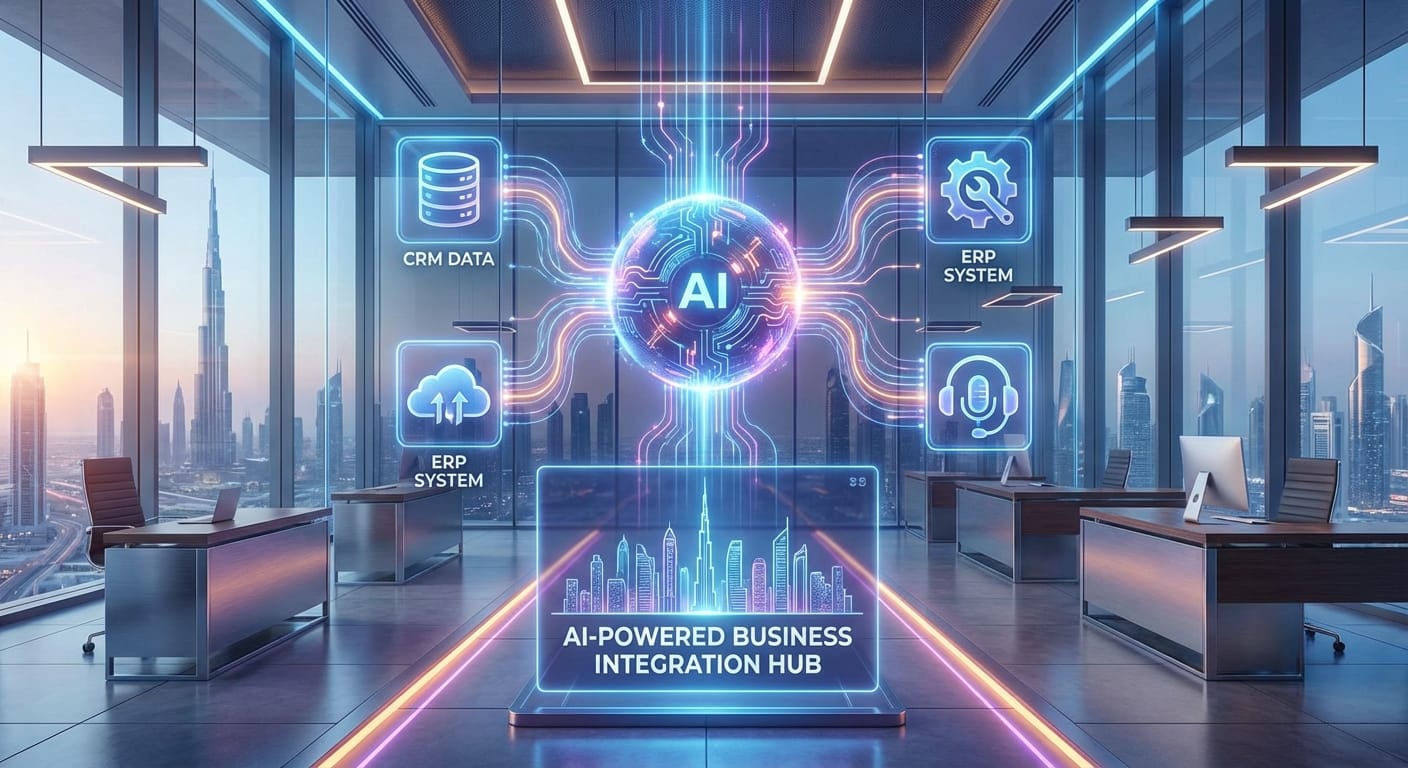
This is where AI Agents truly differentiate themselves. They act as the central nervous system for your operations, connecting disparate software and automating entire workflows. Consider the key capabilities of a truly autonomous agent:
- Goal-Oriented Action: You give the agent an objective, such as "Onboard this new client" or "Process all outstanding invoices," and it formulates and executes the necessary steps.
- Multi-System Integration: It can seamlessly interact with your email, calendar, CRM, ERP, and third-party APIs to gather information and perform actions.
- Continuous Learning: Every task and interaction refines its processes, making it more efficient over time.
- Proactive Execution: It can identify opportunities for action, such as flagging a low-inventory item and automatically generating a purchase order for approval.
Pillar 3: Predictive Maintenance and Asset Management
For industries like logistics, manufacturing, and real estate, unplanned downtime is a primary source of lost revenue. I recall a project with a major logistics entity in Jebel Ali years ago. Their team spent hundreds of hours a week manually tracking asset conditions and reconciling maintenance logs. We implemented an early-stage monitoring system that, while not a true AI agent by today's standards, proved the concept: by analyzing sensor data, we could predict equipment stress and pre-emptively schedule maintenance. Today's AI Agents take this to another level. They can monitor thousands of IoT data points in real-time, diagnose potential failures with incredible accuracy, automatically order replacement parts, and schedule a technician without any human intervention. This shifts the entire maintenance paradigm from reactive repair to predictive uptime.
The Dubai Blueprint: Scaling Intelligence, Not Headcount
In a competitive market like Dubai, growth is paramount, but uncontrolled hiring can cripple profitability. The strategic advantage of AI Agents lies in their ability to decouple business growth from headcount growth. By automating complex, time-consuming tasks, you empower your existing team to achieve more. You are not replacing people; you are augmenting their capabilities and removing the operational friction that slows them down.
The goal is not to replace your human talent, but to amplify it. AI agents handle the operational noise, so your people can focus on the signal-strategy, innovation, and high-value customer relationships.
The return on investment becomes clear when we analyze the performance metrics. A team augmented by AI Agents can achieve outputs that would otherwise require a significantly larger workforce, all while improving accuracy and speed. The data from early adopters in the region paints a compelling picture of operational leverage.
| Performance Metric | Traditional Operations Team | AI Agent-Augmented Team | Observed Improvement |
|---|---|---|---|
| Customer Query Resolution Time | 2-4 Hours (Avg) | Instant to 5 Minutes | 95% Faster |
| Operational Uptime (Manufacturing) | 92% | 99.5% (Predictive Maintenance) | Reduced Downtime by over 90% |
| Time on Repetitive Admin Tasks | 15 Hours/Week per Employee | Less than 1 Hour/Week | 40% Increase in Strategic Capacity |
| First-Contact Resolution Rate | 65% | 85% | Improved Customer Satisfaction |
Your Roadmap to Implementing AI Agents
Adopting this technology doesn't require a complete overhaul of your business. It requires a strategic, phased approach focused on generating maximum impact with minimum disruption. Here is a clear roadmap for any business leader in the Middle East looking to begin this journey:
- Identify High-Impact Processes: Start by identifying the biggest bottlenecks in your organization. Where do repetitive, high-volume tasks consume the most human hours? Customer service, invoice processing, and supply chain coordination are often excellent starting points.
- Define a Clear Pilot Project: Select one well-defined process to automate with an AI Agent. The goal of this pilot is to prove the concept, measure the ROI, and build internal confidence in the technology. Success here will create the momentum for wider adoption.
- Choose an Expert Technology Partner: This is not a standard IT procurement. You need a partner with deep expertise in AI, workflow automation, and system integration. They should act as a strategic advisor, helping you not just deploy the technology but also re-engineer your processes to maximize its potential.
- Integrate, Measure, and Scale: Once the pilot is successful, methodically scale the solution to other parts of your business. Ensure that for every agent you deploy, you have clear key performance indicators (KPIs) to track its impact on efficiency, cost, and customer satisfaction.
Conclusion: The Future of Work is Autonomous
The commercial landscape of Dubai and the wider Middle East is defined by bold ambition. To realize this ambition, we must equip our businesses with equally bold technology. AI Agents are no longer a concept from science fiction; they are a practical, powerful tool for building leaner, smarter, and more scalable enterprises. They represent the ultimate evolution from simple digitalization to true digital transformation, creating an autonomous enterprise that can outpace the competition around the clock.
The question for business leaders is no longer if you should adopt this technology, but how quickly you can integrate it into the core of your operations. The journey starts with a single, strategic step. I encourage you to assess your current workflows and identify the first process you will hand over to your new, autonomous workforce.