


The 3 AM Alert: Why Your IT Operations Model is Broken
For any IT manager, there's a familiar, dreaded sound: the high-priority alert tone that rips through the silence of the night. It signals a critical system failure, triggering a frantic scramble to diagnose, triage, and remediate before business operations grind to a halt. For the 22 years I've spent at the intersection of technology and operations, this reactive, fire-fighting model has been the status quo. But in a hyper-competitive, 24/7 business hub like Dubai's Business Bay, this model is no longer just inefficient; it's a direct threat to the bottom line.
As both an engineer and a PhD scholar in AI and Machine Learning, I've dedicated my career to building systems that don't just follow instructions but learn and adapt. The sheer complexity of today's hybrid cloud environments, microservices architectures, and IoT data streams has outpaced human cognitive capacity. We are drowning in data yet starved for insight. This is the fundamental problem that AIOps (Artificial Intelligence for IT Operations) is designed to solve. It's a paradigm shift from reacting to failures to proactively preventing them before they ever impact your end-users.
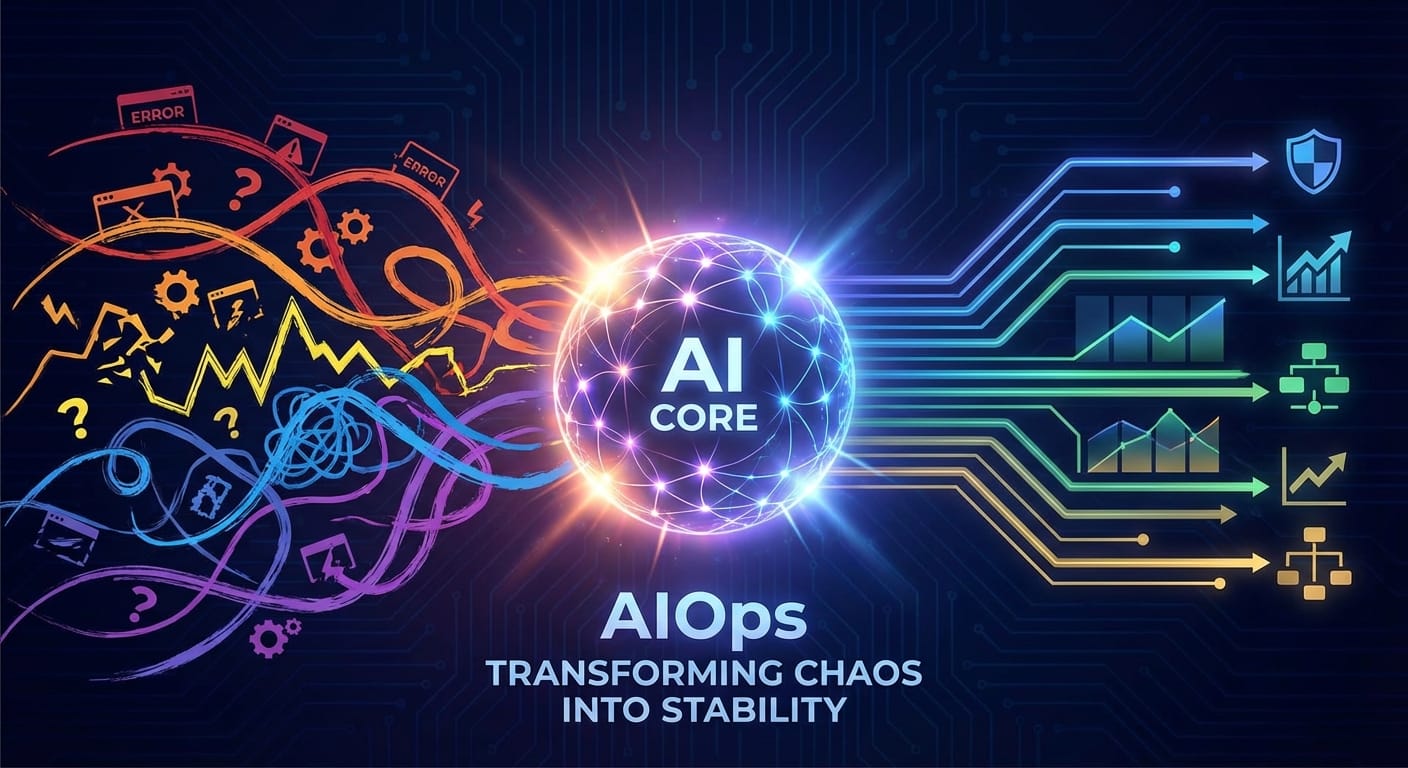
At NICGulf, we are moving beyond traditional monitoring dashboards and static threshold alerts. We are deploying intelligent systems that act as a central nervous system for your IT infrastructure, using machine learning to monitor, analyze, and act with a speed and precision that is simply unattainable for human teams.
The Anatomy of a Modern IT Crisis
To appreciate the solution, we must first dissect the problem. The challenges facing modern IT departments aren't just bigger; they are different in nature. The old playbooks for incident management are failing because the game has fundamentally changed.
The Noise Before the Signal: Alert Fatigue and Data Overload
A typical enterprise infrastructure generates millions of log entries, metrics, and events every single day. Traditional monitoring tools, configured with static thresholds (e.g., "alert when CPU usage exceeds 90%"), create a constant barrage of alerts. Most of these are false positives or low-priority noise, leading to a dangerous phenomenon: alert fatigue. Your skilled engineers become desensitized, and amidst this flood of irrelevant information, the subtle signals of an impending catastrophic failure are often missed.
The Domino Effect: Cascading Failures in Interconnected Systems
I remember a case from a few years ago with a major e-commerce client. Their system went down during a peak sales event. The root cause? A minor, unnoticed memory leak in a seemingly non-critical microservice. This small issue slowly consumed resources, causing a database connection pool to exhaust, which in turn triggered a cascading failure across their payment gateway and inventory management systems. The post-mortem took days. The team had all the data, but they couldn't connect the dots in time. This is a classic example of a complex, non-linear problem that AIOps is uniquely suited to solve.
The goal of modern IT Operations shouldn't be to reduce the Mean Time to Resolution (MTTR). It should be to eliminate the resolution process entirely by focusing on Mean Time to Prevention (MTTP). AIOps makes this possible.
AIOps in Practice: NICGulf's Machine Learning-Driven Approach
AIOps isn't magic; it's the application of sophisticated machine learning algorithms to IT operational data. At NICGulf, we build and deploy AIOps platforms that transform your IT department from a reactive cost center into a proactive, strategic asset. Here's how it works under the hood.
Our framework is built on several core ML-driven capabilities:
- Unified Data Aggregation: We ingest and centralize data from all your disparate sources-logs, metrics, application performance monitoring (APM), network traces, and help desk tickets-into a single data lake.
- Intelligent Anomaly Detection: Our ML models learn the normal operational baseline of your entire IT stack. They don't rely on static thresholds. Instead, they identify subtle deviations from this learned "heartbeat," flagging potential issues long before they breach a critical limit.
- Automated Causal Analysis: When an anomaly is detected, the platform doesn't just send an alert. It correlates related events across the entire infrastructure to pinpoint the root cause, distinguishing symptoms from the source of the problem.
- Predictive Analytics & Automated Remediation: By analyzing historical data, the system can predict future resource needs or potential failures. It can then trigger automated workflows-like scaling resources, restarting a service, or re-routing traffic-to resolve the issue before it ever becomes an incident.
- The quantifiable impact of this approach is staggering when compared to traditional methods.
- *Based on industry averages for a mid-sized enterprise with an estimated downtime cost of $5,600 per minute.
- Implementing an AIOps solution is a strategic journey. Our process at NICGulf is designed to be collaborative and value-driven, ensuring a smooth transition to a more intelligent operational model.
- Discovery and Baselining: We start by mapping your entire IT ecosystem and data sources. We deploy data collectors and allow our ML models to passively learn the unique operational patterns of your business for an initial period.
- Model Customization and Integration: We fine-tune our anomaly detection and correlation algorithms based on your specific infrastructure and business priorities. We then integrate the platform with your existing ITSM tools like ServiceNow or Jira.
- Automated Workflow Configuration: We work with your team to define and build automated remediation playbooks for common, predictable issues, starting with non-disruptive actions and gradually increasing the level of automation.
- Continuous Optimization: An AIOps platform is a living system. It continuously learns from every new event and incident, becoming smarter and more accurate over time. We provide ongoing support to ensure the system evolves with your business.
- For IT leaders in Dubai and across the globe, the mandate is clear: we must evolve. The reactive, human-centric model of IT operations is a relic of a simpler time. AIOps offers a tangible, data-driven path toward building a resilient, self-healing, and cost-effective infrastructure. It allows you to shift your most valuable resource-your people-from mundane, repetitive tasks to high-value strategic initiatives that drive business growth.
- The technology to predict and prevent system failures is no longer science fiction; it is a deployable reality. If you are ready to move beyond the 3 AM alert and transform your IT operations into a proactive engine for innovation, I encourage you to reach out to our team at NICGulf. Let's architect an intelligent future for your enterprise.
Conclusion: Stop Fighting Fires and Start Preventing Them
Deploying AIOps: Your Path to a Self-Healing Infrastructure
| Metric | Traditional IT Monitoring | NICGulf AIOps Platform | Business Impact |
|---|---|---|---|
| Mean Time to Resolution (MTTR) | 4-6 Hours | Under 30 Minutes (Often automated) | ~90% Faster Recovery |
| Incident Escalation Rate | ~75% to Level 2/3 Engineers | <20% | Frees Up Senior Talent |
| Downtime-Related Revenue Loss* | ~ $300,000 / year | < $40,000 / year | Significant Cost Savings |
| Proactive Problem Identification | Rare (Manual analysis) | ~60% of issues detected pre-impact | Enhanced System Reliability |