


From my vantage point here in Dubai, a city that literally builds the future in its skyline, I hear a familiar, nervous whisper echoing through the creative industries globally: "AI is coming for our jobs." Artists, writers, designers, and strategists are watching tools like Midjourney and GPT-4 produce seemingly creative outputs in seconds, and they are asking a legitimate question: Are we becoming obsolete?
After more than 17 years spent integrating advanced technology and AI strategy for over 40 of the UAE's most forward-thinking government entities, including the Prime Minister's Office, my perspective is different. I've seen firsthand how technology acts as a catalyst for transformation. AI isn't the executioner of creativity. It's the great revealer. It's a powerful, clarifying force that is unbundling the tasks we once lumped together under the "creative" umbrella, and in doing so, it's exposing who was truly creating and who was simply executing a high-level assembly line of tasks.
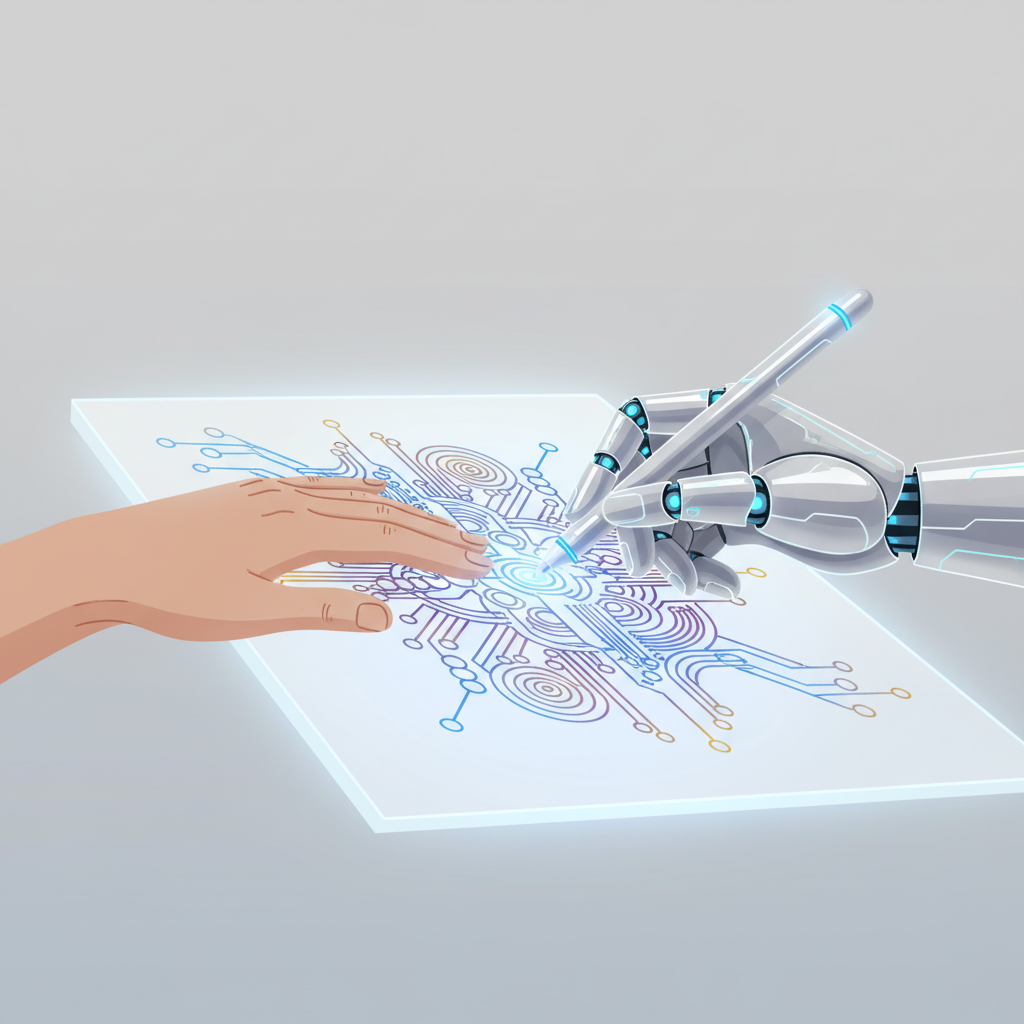
The fear is based on a fundamental misunderstanding of what creativity is. It isn't just about the final output-the image, the article, or the design. It is the messy, human process of inquiry, synthesis, strategic intent, and emotional resonance that precedes it. AI can generate an image, but it cannot have the vision for a national brand campaign. It can write an article, but it cannot devise a thought leadership strategy that shifts market perception. The tool is not the artist. The panic is not about a loss of creativity; it's about the automation of craft.
The Great Unbundling of 'Creative' Work
For decades, many "creative" roles have been a bundle of disparate tasks. A graphic designer wasn't just an ideator; they were a master of Adobe Suite's technical intricacies. A copywriter wasn't just a wordsmith; they were a human search engine for styles and formats. A large portion of their time was spent on the mechanical aspects of their craft-the 'how' of creation, not the 'why'.
From Production to Provocation
AI is systematically automating the production components of these roles. It can generate a thousand variations of a logo, draft a social media calendar, or code a website layout with terrifying efficiency. This is where the fear stems from. But this automation doesn't eliminate the need for the creative professional; it fundamentally changes their role. It frees them from the tyranny of the blinking cursor or the blank canvas and elevates their work from production to provocation. The value is no longer in the manual skill of creating ten versions of a graphic, but in the strategic mind that can provide the vision for the one version that matters. The human is no longer the engine; they are the navigator.
The Illusion of Creative Output
We have long been conditioned to equate volume and speed with creative prowess. An agency that could produce a campaign in a week was seen as more creative than one that took a month. But were they more creative, or just more efficient at the production process? AI has shattered this illusion. It can out-produce any human team. Therefore, the metric of success must shift from output to outcome. The question is no longer "How much did you make?" but "How much impact did your vision create?" This forces a return to the core of creativity: the novel idea, the strategic insight, the unexpected connection, and the emotional truth.
AI as a Catalyst, Not a Competitor
True creativity is not a solitary act of genius; it's a process of connection and iteration. Viewing AI as a competitor is a failure of imagination. When you embrace it as a catalyst-a tireless, infinitely knowledgeable brainstorming partner-you unlock a new paradigm of innovation.
I recall a project a few years ago with a key government department responsible for shaping a nationwide public service campaign. The creative team was brilliant but stuck in a rut, cycling through the same few concepts. They were understandably skeptical when I proposed using an AI model for ideation. We fed the model our core strategic pillars-community, sustainability, and future-readiness-along with data on target demographics. In under an hour, it generated over 200 distinct campaign slogans, visual concepts, and narrative hooks. Ninety percent of it was unusable, generic, or culturally misaligned. But within the remaining ten percent were sparks of genius-unusual word pairings and conceptual links the human team had never considered. The AI didn't give them the final answer. It gave them a vast, unexplored landscape of possibilities. The human team's true creative work began there: curating, refining, and synthesizing these sparks into a single, powerful campaign that went on to exceed all its engagement targets. The AI provided the quantity; the humans provided the quality and the soul.
AI provides the infinite canvas and the endless supply of paint; it is the human artist who must possess the vision to create a masterpiece. The value is shifting from the hand that holds the brush to the mind that guides it.
Redefining Creative Skillsets for the AI Era
The rise of AI necessitates a profound shift in the skills we value. Technical mastery of specific software is becoming less critical than the cognitive and strategic abilities that guide the tools. The creative professional of the future is less of a specialist technician and more of a strategic conductor.
As roles evolve, the demand for specific skills is changing dramatically. Industry analysis shows a clear pivot from technical execution to strategic oversight. Here's how the landscape is shifting:
| Skill Category | Pre-AI Era Emphasis | AI-Era Emphasis | Projected 5-Year Growth |
|---|---|---|---|
| Technical Proficiency | Mastery of specific tools (e.g., Photoshop, Final Cut Pro) | Ability to integrate various AI tools into a workflow | -15% |
| Strategic Vision | Developing campaign briefs and concepts | Defining the 'why,' setting goals, and ensuring AI output aligns with brand identity | +45% |
| Curation & Editing | Refining human-generated content | Critically selecting, editing, and synthesizing the best of AI-generated outputs | +60% |
| Prompt Engineering | N/A | The art of asking precise, context-rich questions to guide AI effectively | +85% |
The most successful creatives will be those who cultivate skills that AI cannot replicate. These are the core human competencies that become more valuable, not less, in an age of automation:
- Critical Judgment: The ability to discern quality, relevance, and nuance from a sea of AI-generated options.
- Emotional Intelligence: The skill of infusing work with empathy, humor, and cultural understanding to create a genuine human connection.
- Ethical Oversight: The wisdom to ensure that AI-driven creative work is responsible, unbiased, and aligned with human values.
- Cross-Disciplinary Synthesis: The vision to connect disparate ideas from different fields-art, science, business, and technology-to forge something entirely new.
The Path Forward: From Fear to Fusion
Adapting to this new reality is not about becoming a machine operator. It's about becoming a more strategic, visionary, and ultimately more human creator. The path forward is not one of resistance but of intelligent integration. Here is how you can thrive:
- Embrace Your Role as a Conductor: Stop seeing yourself as the person who plays every instrument. Your job is to orchestrate the tools-AI included-to realize a singular, coherent vision. Your value is in your taste, your direction, and your strategy.
- Master the Art of the Question: The quality of your AI-generated output is directly proportional to the quality of your input. Learning how to ask insightful, specific, and context-aware questions (prompt engineering) is the new essential creative skill.
- Double Down on Your 'Why': With the 'how' becoming increasingly automated, your unique purpose, perspective, and strategic goals are your greatest assets. AI can execute a task, but you provide the intent. This is your moat.
- Cultivate a Mindset of Perpetual Learning: The AI tools of today will be obsolete tomorrow. The only sustainable skill is the ability to adapt, learn, and integrate new technologies into your creative process without losing sight of your strategic goals.
Conclusion: The Future Belongs to the Visionaries
AI is not the death of creativity. It is the death of mediocrity. It automates the formulaic, the repetitive, and the uninspired. It exposes workflows that relied on technical process rather than true ingenuity. What is left is the core of human creativity: vision, taste, strategic intent, and the courage to connect ideas in new ways.
Here in the UAE, we are not afraid of the future; we are actively building it. We see AI not as a threat, but as a tool to amplify human potential. The challenge for creatives everywhere is to rise to the occasion. Stop worrying about being replaced by a tool and start becoming the visionary that no tool can replace.
I challenge you to ask yourself: in your work, are you a creator or an operator? The answer will define your future. I'd love to hear your thoughts in the comments below.